


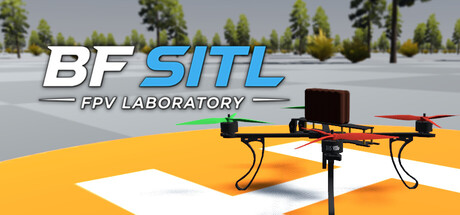
BF SITL - FPV Laboratory
Can my PC run BF SITL - FPV Laboratory
Find out whether your PC can run this game by reviewing the minimum and recommended requirements below.
Game Details
Minimum Requirements
Recommended Requirements
Game Description
BF SITL - FPV Laboratory is a physics-first quadcopter simulator where every motor, propeller, and battery behaves like its real-world counterpart. Validate builds, optimize efficiency, and tune flight controllers with lab-grade accuracy — without risking crashes, burned components, or wasted money.
This is not just a flying simulator — it's a testing environment for real-world multirotor systems.
Why BF SITL - FPV Laboratory?
Test motor and prop combinations before buying real hardware
Tune Betaflight with real physics feedback instead of guesswork
Validate heavy-lift builds and payload configurations safely
Transfer your tuning directly to real drones
Lab-Grade Physics at 1000Hz
Every motor, propeller, and battery is modeled from real bench test data. The VMG (Voltage-Motor-Generator) engine runs a full torque-balance simulation at 1000Hz using Jolt Physics:
Motor iron losses (eddy current + hysteresis) calibrated from real dyno data
Per-propeller thrust and torque coefficients fitted across multiple motor+prop combinations
LiPo discharge with voltage sag, internal resistance, and state-of-charge tracking
ESC dead-time losses, timing advance, current limiting, and thermal derating
Aerodynamic drag via virtual wind tunnel with shader-based surface analysis
Vibration injection into simulated gyro and accelerometer sensors
Two Modes of Operation
SIM Mode — A built-in PID flight controller with ACRO, ANGLE, and HORIZON modes. Tune PID gains and rates in real time. Perfect for learning, prototyping, and rapid testing.
SITL Mode — Connect directly to real Betaflight firmware running on your PC. BF-SITL Laboratory exchanges data at 1000Hz, allowing you to test real firmware behavior with full physics simulation.
No proxies, no external tools — just launch SITL and connect.
Virtual Workbench
A real-time engineering workspace for building and analyzing quadcopters:
Thrust-to-weight ratio, max current draw, hover throttle, and flight time estimates
Throttle sweep analysis with efficiency curves
Payload attach/detach simulation
Multiple frame sizes, motors, and propellers based on real-world specs
Procedural Motor Audio
Procedural motor audio generated from RPM, current, and thrust — no samples, fully dynamic. Blade-pass harmonics, electromagnetic whine, aero noise, and sub-bass rumble respond instantly to throttle changes.
Built for Precision
1000Hz physics tick rate with Jolt Physics engine
FPV camera with lens distortion, chromatic aberration, and vignetting
Real-time OSD: altitude, speed, battery voltage, per-cell monitoring, motor outputs
Debug graphs for any telemetry channel
Force visualization: thrust vectors, drag forces, center of mass/pressure markers
Full joystick and RC transmitter support with per-device mapping
Session persistence — layouts, builds, and settings saved automatically
Who Is This For?
FPV pilots testing setups before building real drones
Drone engineers validating Betaflight firmware via SITL
RC hobbyists learning PID tuning without risk
Anyone interested in multirotor physics and system behavior
BF-SITL Laboratory is not affiliated with or endorsed by the Betaflight project. "Betaflight" is a trademark of its respective owners.