



HANGAR 51: Classified Investigation
Can my PC run HANGAR 51: Classified Investigation
Find out whether your PC can run this game by reviewing the minimum and recommended requirements below.
Game Details
Minimum Requirements
Recommended Requirements
Game Description
Enter HANGAR 51, follow the protocol.
Don’t trust the lights. Don’t trust the recordings.
And whatever you do, don’t open sealed doors without authorization.
WELCOME TO HANGAR 51
HANGAR 51 is a first-person investigation game set inside a sealed 1980s bunker. You play as an inspector sent to examine what remains after a classified incident. The official reports are incomplete, the evidence is scattered, and the facility feels frozen in time. Your mission is to reconstruct the truth.
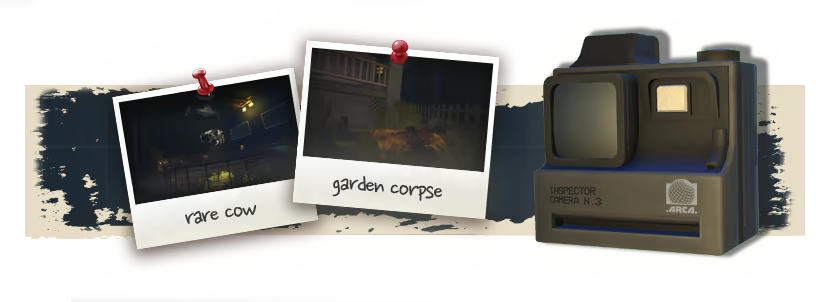
YOUR CAMERA IS YOUR MAIN TOOL
You don’t just look for clues, you document them. As you explore and solve puzzles, you must use your camera to capture the details that matter:
Photograph suspicious objects, environments, and anomalies
Capture visual evidence that supports (or contradicts) official records
Decide what is worth documenting and what can be ignored
What you choose to photograph directly affects your investigation.
A FIRST-PERSON INVESTIGATION GAME
This is a slow-paced investigation experience focused on observation, deduction, and evidence gathering. You will explore the bunker room by room, searching for clues, anomalies, documents, and objects that don’t quite add up and deciding what is relevant.
Search offices, labs, storage rooms, and containment corridors
Collect key items, codes, and access cards
Reconstruct the incident through documents, terminals, and audio logs
Solve interconnected puzzles that make the facility feel like a real place

THE FINAL REPORT
At the end of your investigation, you must compile your findings into a final report. What you documented and what you missed will shape your conclusions.